

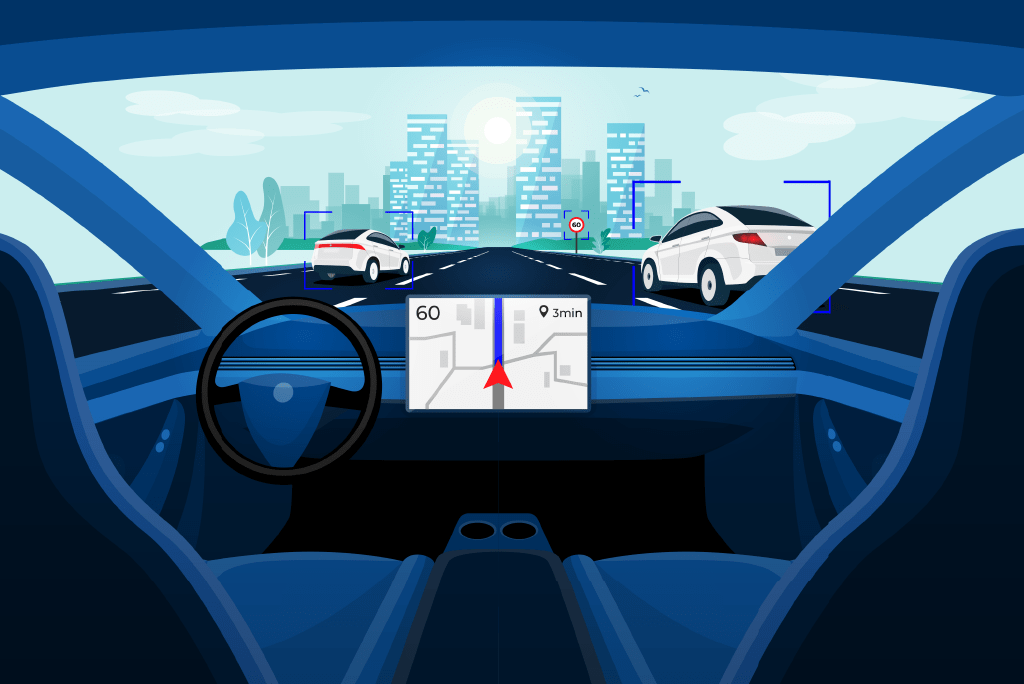
The hype around autonomous vehicles (AVs) for consumer use has been growing at an almost exponential rate since Elon Musk announced anyone would be able to sleep in their car on the way to work in 2016. However, the implementation of AVs is much more complicated than simply selling cars that can drive themselves. The AV industry faces a double-edge sword as they must navigate an unregulated world as developers and as distributors. The main challenges are cost, safety, and regulation which influences the behavior of consumers. On top of the basic challenges, AV software is prompting the development of submarkets such as robotaxis, in-car entertainment, or smart infrastructure to name a few. Mobility as a Service, or MaaS, is a new strategy that several companies will use to navigate challenges and capitalize in the market.
The concept of integrating movement as a business solution seems to be the next phase of AV implementation. Prior to the widespread adoption of consumer autonomous vehicles, we can expect the transition to autonomous technology in delivery services, taxis, and public transportation. Many of the top competitors in the industry have realized this trend and positioned themselves to offer MaaS. For example, this year Amazon and Google have begun testing robot taxis (robotaxis) in multiple cities as they try to scale and test the strategy’s viability.
Benefits of the MaaS Model
Two key benefits of MaaS are consumer visibility and new revenue streams. AVs as a consumer product are predicted to be widespread by 2030, meaning that 7-10 years of development is still necessary at a minimum before direct sales to the consumer. By entering the public eye now through MaaS, companies can become a name brand for robotaxis similar to Tesla’s long-term development to be the name brand for electric cars or Uber as the name brand of rideshare services. New revenue streams are then realized from the service and the byproduct of AV software in action. Mobileye, Intel’s branch of AV production, has generated a map database by collecting on-road information through its AV software, resulting in crowdsourced map data that is continuously updated. Mobileye estimated the maps could be licensed and sold for a total revenue stream of over 100 million dollars. Further development of MaaS and robotaxis will open doors similar to the one Mobileye unlocked and more untapped revenue streams.
Challenges of the Maas Model
Mobility as a service must consider scope and consumer acceptance when choosing the MaaS model. The strategy itself takes the technology of AVs to the consumer, therefore companies must vertically integrate downstream. Downstream integration of AV companies will lead to increased competition with other consumer facing products such as Uber or Amazon. This requires further investment to provide a proper service and could spread a company’s resources too thin. For example, to provide consumers with an optimal robotaxi experience, companies must purchase and manage localized fleets capable of using the software. An investment which entails a substantial upfront cost, and without widespread adoption of AV services, it may result in a significant financial loss. Companies also face the competition of consumer acceptance. Even if consumers choose to use AV services, there is going to be a hierarchy of competitors. Take Google as an example of consumer acceptance in tech. Google’s search engine gives almost identical answers to Bing and Yahoo, but no one is saying “let’s Bing that!” AV services may be identical but if the consumer doesn’t choose it, it won’t sell.
The future of MaaS
Many companies will incorporate the MaaS model, but we will have to wait to see the full return on investment. It will be interesting to watch a top-notch technology race unfold and force the hand of many companies. I think we will be seeing a re-shuffle of strategies quite soon after robotaxis are rolled out and the testing phase is complete. Many companies may have the difficult decision of cannibalizing their ideas and focusing on other niche markets created by the AV.
 Dual Waters